
AI Search Brief
← Back to calendar

Friday, August 7, 2026

14 articles

AI Search Only Feels New If Your SEO Was Shallow
Search Engine Journal·Aug 7, 2026
Good to Know

AI Search Only Feels New If Your SEO Was Shallow

Key Takeaways

  • The core SEO principles—technical excellence, authoritative content, topical depth—remain the foundation for AI search visibility, not a separate discipline.
  • Practitioners panicking about AI search often skipped foundational SEO work and are now reacting to a shift they should have anticipated.
  • Rebranding SEO as 'GEO' or 'AEO' is a distraction; the underlying work—building trust, depth, and relevance—is unchanged.
  • Sites with shallow content strategies and weak authority signals face disruption in AI search because those weaknesses were always liabilities.
  • The transition to AI search is not a reset; it rewards the same fundamentals that worked in traditional search.

Why it matters: If you've built SEO on solid fundamentals—technical health, topical authority, and genuine expertise—AI search is an evolution, not a threat. If your strategy relied on shortcuts or thin content, AI search exposes that gap. The takeaway: focus on depth and authority now, not on chasing new terminology or tactics.

AI SearchSEO FundamentalsContent StrategyAuthority Building
ChatGPT Ads rolls out oCPC campaigns, AAM and product carousels
Search Engine Land·Aug 7, 2026
Important

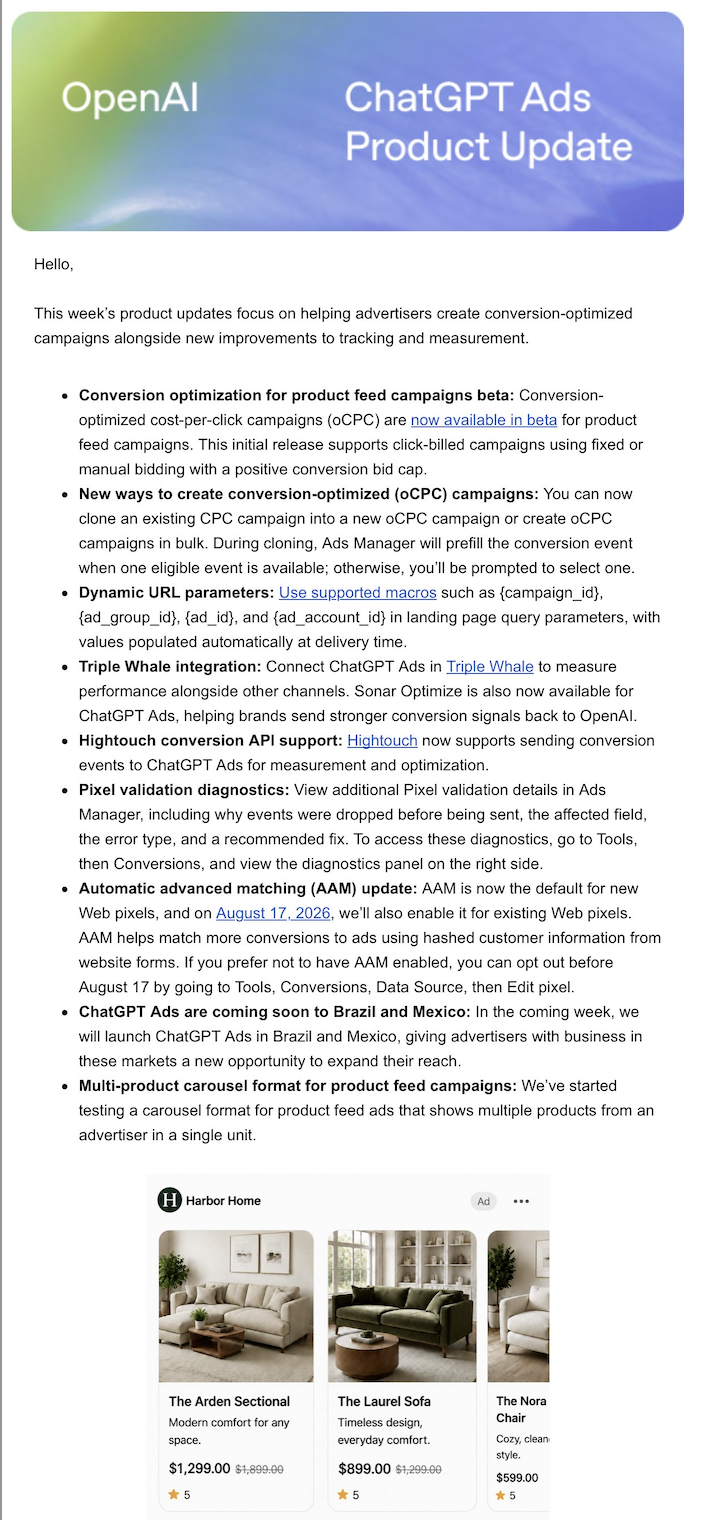
ChatGPT Ads rolls out oCPC campaigns, AAM and product carousels

Key Takeaways

  • oCPC campaigns now available in beta for product feed campaigns, with bulk cloning and campaign migration tools to simplify setup
  • Automatic Advanced Matching (AAM) becomes default for all new pixels immediately and existing pixels on August 17 unless opted out
  • New integrations with Triple Whale, Sonar Optimize, and Hightouch enable stronger conversion signal passing and cross-channel measurement
  • Dynamic URL parameters automatically append campaign, ad group, and ad IDs for improved attribution tracking
  • Multi-product carousel format testing for product feed campaigns to display multiple products in single ad units

Why it matters: ChatGPT Ads is maturing as a performance advertising channel with conversion optimization and measurement parity to Google and Meta. If you're running product feed campaigns or considering ChatGPT Ads for ecommerce, these tools reduce setup friction and improve attribution accuracy. The AAM default change means you need to audit your pixel implementation before August 17 or risk losing conversion signal strength.

ChatGPT AdsConversion OptimizationPerformance MarketingProduct FeedsAttribution
Google expands Limited Ad Serving policy across all Ads
Search Engine Land·Aug 7, 2026
Important

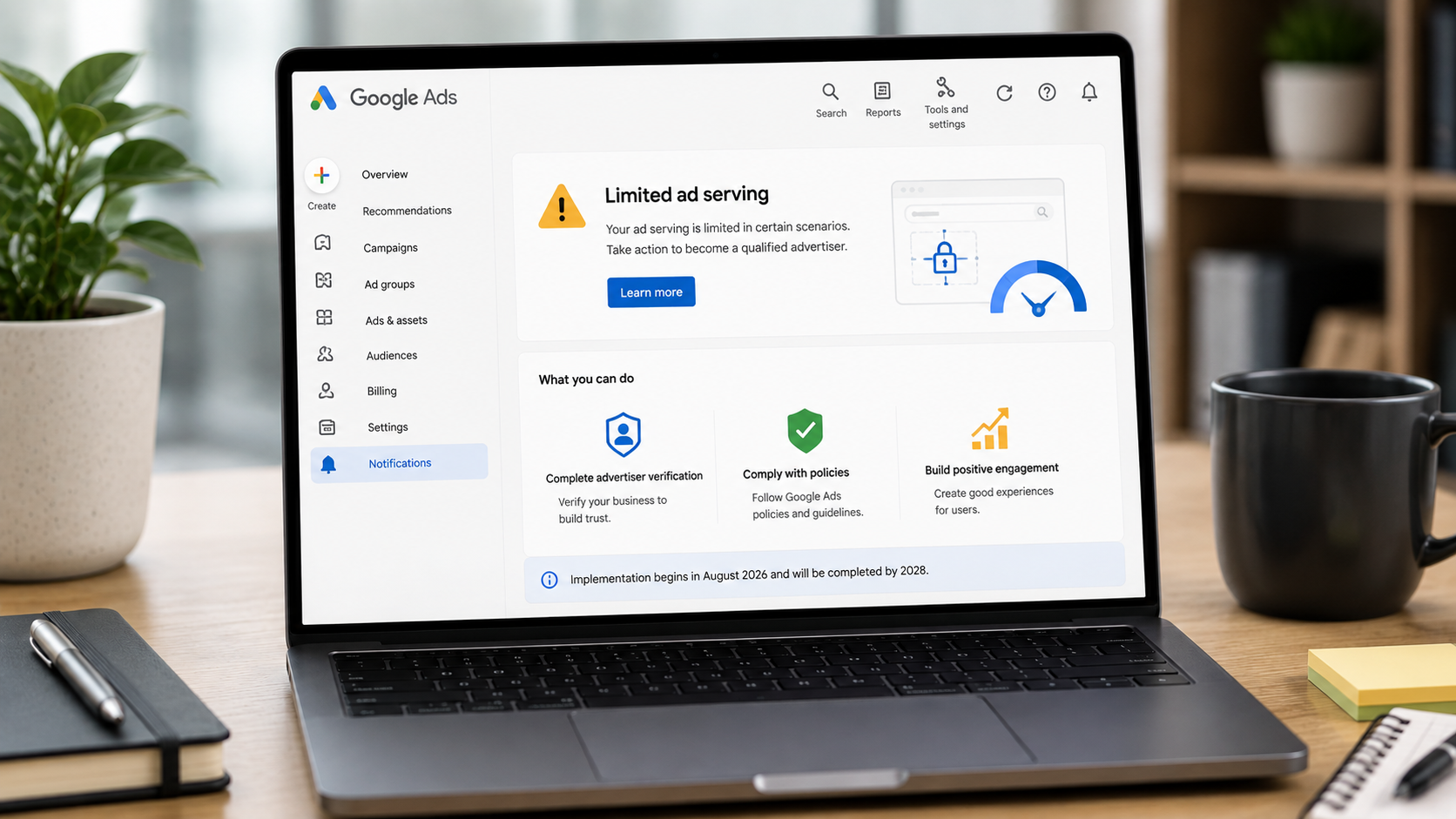
Google expands Limited Ad Serving policy across all Ads

Key Takeaways

  • Impression limits (not ad disapprovals) will apply to accounts Google considers unqualified, based on account maturity, advertiser verification, policy compliance history, user reports, ad format usage, and industry attributes.
  • Advertisers with strong trust signals are unaffected; limited accounts receive in-account notifications and can appeal via Google's Limited Ad Serving Appeals Form.
  • Google recommends building trust through advertiser verification, policy compliance, clear branding, and for Search campaigns, avoiding generic copy and pinning domain to first headline.
  • Rollout begins August 2024 and will be implemented gradually through 2028 across Search, YouTube, Gmail, Discover, and Play Store.

Why it matters: Paid search and display advertisers need to understand that Google is now systematically limiting reach for accounts it deems lower-trust, making advertiser verification and policy compliance essential to avoid impression caps. Newer or smaller accounts should prioritize verification and brand consistency now to avoid restrictions during the rollout period.

Google Ads PolicyLimited Ad ServingAdvertiser VerificationAccount Trust SignalsPaid Search
Microsoft Advertising adds bulk editing for disapproved assets
Search Engine Land·Aug 7, 2026
Good to Know

Microsoft Advertising adds bulk editing for disapproved assets

Key Takeaways

  • Bulk edit and appeal feature is now available in all Microsoft Ads accounts for both text and image assets
  • Appeals must be submitted for all disapproved assets within an ad, but approved assets can continue serving during review if the final URL remains approved
  • For image assets, advertisers must upload replacement images rather than edit existing creatives
  • Advertisers can submit up to 5,000 ad exception requests
  • Feature reduces operational friction for teams managing large numbers of assets at scale

Why it matters: This streamlines campaign management for Microsoft Ads users handling disapprovals at scale, cutting down the manual work of addressing policy issues one asset at a time. For agencies and large advertisers, the bulk workflow saves significant time on compliance and appeals, though the per-asset review requirement means some limitations remain.

Microsoft AdvertisingBulk EditingPolicy ManagementCampaign Tools
YouTube tests image ads during horizontal mobile playback
Search Engine Land·Aug 7, 2026
Good to Know

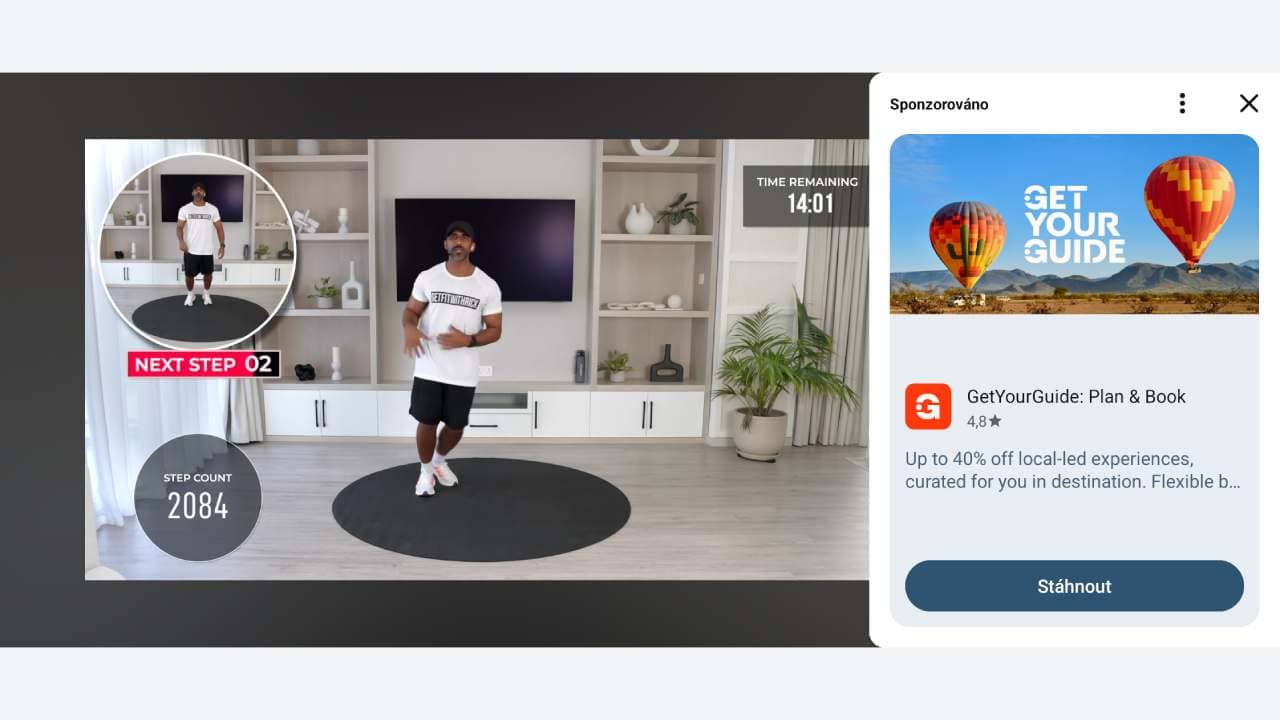
YouTube tests image ads during horizontal mobile playback

Key Takeaways

  • Image ads appear every ~3 minutes during landscape playback, more frequently than standard YouTube video ad breaks
  • Ads overlay on-screen without pausing or replacing video content, creating a less-intrusive format than pre-roll or mid-roll ads
  • Format requires no video creative from advertisers, lowering production barriers for participation
  • Google has not confirmed whether this is a limited test or planned for broader rollout
  • The change could increase overall ad frequency and reshape mobile viewing experience even without content interruption

Why it matters: If rolled out broadly, this format could increase ad load on mobile video without traditional interruptions, affecting both user experience and advertiser reach. Practitioners should monitor whether this becomes standard, as it represents YouTube's continued push to expand monetization inventory and may influence content strategy for mobile-first audiences.

YouTube AdsMobile AdvertisingAd FormatsVideo Monetization
Google Ads adds dedicated reporting for new customer acquisition
Search Engine Land·Aug 7, 2026
Important

Google Ads adds dedicated reporting for new customer acquisition

Key Takeaways

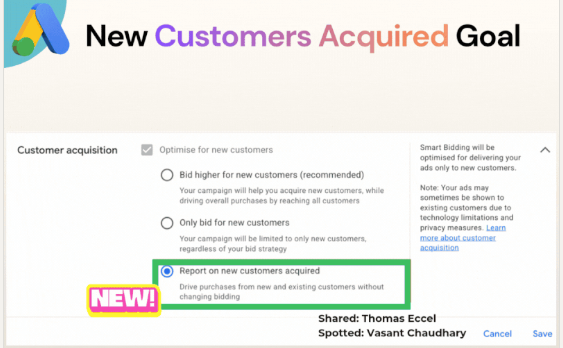
  • Advertisers can now select "Report on new customers acquired" to unlock New customers and New customer value columns without any bidding adjustments
  • The update replaces a widespread workaround where advertisers set bid multipliers to 0.01 to access new-versus-existing customer reporting without practical bidding impact
  • The feature separates measurement from optimization, letting advertisers track acquisition performance independently of Google's bidding strategy
  • This reflects Google's broader effort to expand reporting controls and reduce reliance on unofficial hacks as advertisers focus on customer lifetime value and acquisition efficiency

Why it matters: PPC practitioners managing customer acquisition campaigns can now cleanly measure new customer performance without the friction of workarounds or unintended bidding side effects. This simplifies reporting workflows and gives clearer visibility into acquisition efficiency, which is increasingly critical as advertisers optimize for customer lifetime value rather than just conversion volume.

Google AdsCustomer AcquisitionPPC ReportingBidding Strategy
How business context changes AI recommendations
Search Engine Land·Aug 7, 2026
Good to Know

How business context changes AI recommendations

Key Takeaways

  • Without explicit business context, AI models don't just fill in missing facts—they fill in missing intent, each supplying its own interpretation of the underlying problem.
  • Adding concrete business details (company type, budget, objectives, constraints, revenue drivers) transformed vague recommendations into commercially relevant guidance aligned to the same challenge.
  • All three models retained their characteristic approaches (Claude discovery-focused, Gemini technical, ChatGPT framework-driven) but their outputs became more useful and aligned when grounded in the same business context.
  • A prompt is the visible artifact of discovery, research, business judgment, and editorial review—sharing a prompt alone obscures the conversations, assumptions, and priorities that shaped it.
  • Strategic judgment remains essential after AI generates possibilities; a technically valid recommendation can still be a poor investment if it lacks evidence of customer demand or alignment with objectives.

Why it matters: SEO and AI-search professionals often chase impressive AI outputs by requesting prompts, but this article shows that the real value lies in the business context and strategic thinking that precedes the prompt. Understanding how to brief AI models with clear objectives, constraints, and business details—rather than relying on prompt engineering alone—will produce more actionable recommendations for your clients or internal teams. This shifts the focus from prompt tricks to strategic discovery work, which is where competitive advantage actually lives.

AI Model BehaviorStrategic BriefingBusiness ContextPrompt EngineeringAI Recommendations
Gen Z Now Treats Claude And OpenAI Like Consumer Brands, But Trust Is Still An Issue
Search Engine Journal·Aug 7, 2026
Good to Know

Gen Z Now Treats Claude And OpenAI Like Consumer Brands, But Trust Is Still An Issue

Key Takeaways

  • Claude and OpenAI doubled Gen Z consideration scores in Q2 2026
  • Only 28% of Americans trust AI assistants for answers, indicating a major trust deficit
  • The gap between brand familiarity and trust should reshape GEO (Generative Engine Optimization) planning
  • Gen Z treats AI assistants like consumer brands despite broader trust concerns
  • Trust levels remain a critical barrier to AI assistant adoption across the general population

Why it matters: For SEO and AI-search professionals, this data reveals that visibility in AI assistants alone is insufficient—brands must also build trust signals to convert AI mentions into actual user engagement. The 28% trust figure suggests that content strategies focused purely on AI citations without addressing credibility and authority will underperform. GEO strategies need to account for this trust gap when planning content positioning and brand messaging.

Gen Z BehaviorAI TrustGEO StrategyBrand ConsiderationAI Assistants
What six perspectives reveal about demand generation in AI search
Search Engine Land·Aug 7, 2026
Important

What six perspectives reveal about demand generation in AI search

Key Takeaways

  • 68% of Google searches now end without a click (up from 60% in 2024), with AI Overviews cutting CTR by nearly 60% when present; marketers should replace traffic dashboards with correlation tracking of brand and demand signals.
  • Original data, proprietary research, and digital PR (the 'moat') correlate with AI visibility at 0.50-0.74, while backlinks and ad spend sit below 0.30—a signal to shift from link building toward earned placements.
  • AMEC's GEO Principles distinguish visibility (appearing in AI output) from outcomes (whether that appearance drives purchase decisions), requiring 'combined evidence' rather than single-metric dashboards.
  • Brands can be cited by AI engines but lose reputation if audiences don't believe what the AI says; proof-based levers (innovation, products, workplace) outperform posture-based ones (leadership claims) by roughly 2:1.
  • For B2B, analyst content is a primary upstream source shaping AI-generated consideration sets; AR teams can now measure which analyst framing AI models reproduce and where positioning gaps exist.

Why it matters: Practitioners can no longer rely on traffic metrics or single-tool scores to measure SEO and demand-gen success in AI search. These six frameworks—spanning zero-click strategy, content authority, PR measurement, credibility, analyst relations, and citation quality—provide a practical toolkit for measuring influence across the upstream sources AI engines draw from, and connecting that visibility to actual business outcomes through triangulated evidence.

AI Search MeasurementZero-Click MarketingGEO TacticsContent AuthorityB2B Demand Generation
Google’s Ex-AI Chief Jeff Dean Explains How To Improve Context Engineering
Search Engine Journal·Aug 7, 2026
Good to Know

Google’s Ex-AI Chief Jeff Dean Explains How To Improve Context Engineering

Key Takeaways

  • Model selection is declining in importance as a differentiator; context engineering is where competitive advantage now lies
  • Context engineering involves designing and optimizing the information fed into AI systems to improve output quality
  • Dean's perspective reflects a shift in AI development priorities from model architecture to prompt and context optimization
  • This insight applies to practitioners building AI-powered search and content systems

Why it matters: For SEO and AI-search professionals, this signals that success depends less on which LLM you use and more on how you structure the data and prompts feeding those models. Teams should prioritize context optimization strategies—including data curation, prompt design, and retrieval quality—over chasing the latest model releases.

Context EngineeringAI ModelsPrompt OptimizationAI Search
How Cats.txt Showed LLMs.txt Evidence Is GEO Astrology
Search Engine Journal·Aug 7, 2026
Good to Know

How Cats.txt Showed LLMs.txt Evidence Is GEO Astrology

Key Takeaways

  • Cats.txt is a humorous, non-standard file that some SEOs began citing as an optimization signal alongside llms.txt
  • The parallel treatment of cats.txt and llms.txt demonstrates that SEOs are making claims about llms.txt without solid evidence
  • The article frames this as 'GEO astrology'—treating unproven signals as if they were established ranking factors
  • No major search engine or AI platform has confirmed llms.txt as a ranking or discovery signal
  • The piece critiques the SEO industry's tendency to adopt optimization tactics based on speculation rather than platform confirmation

Why it matters: If llms.txt lacks confirmed impact on AI discovery or rankings, SEOs spending time optimizing for it are wasting resources. This highlights the broader risk of treating unconfirmed signals as actionable strategy, especially in the emerging AI-search space where platforms have not officially endorsed these files as optimization levers.

LLMs.txtUnconfirmed SignalsSEO SpeculationAI Discovery
Your rankings aren’t telling you what your customers see
Search Engine Land·Aug 7, 2026
Important

Your rankings aren’t telling you what your customers see

Key Takeaways

  • Ranking first organically often means appearing halfway down the page after ads, AI Overviews, local results, and other Google features—position no longer equals visibility.
  • Google's results are heavily personalized by location, device, search history, and intent; a single ranking report under controlled conditions does not reflect what individual customers see.
  • Click-through rate, impressions, and conversion data reveal performance that rankings alone miss; a third-place result can outperform a first-place ranking if the listing is more compelling or less buried by features.
  • AI Overviews and other Google-owned features now answer questions without requiring clicks, widening the gap between rankings and actual traffic.
  • SEO success should be measured by business outcomes—inquiries, leads, revenue, qualified traffic—not position improvements; a drop from position 1 to 3 is irrelevant if conversions increase.

Why it matters: If you're still reporting rankings as the primary KPI to clients or using position as your main success metric, you're missing the real story and setting false expectations. Clients care about business results, not rankings, and Google's increasingly personalized, feature-rich results mean a high ranking no longer guarantees visibility or clicks. Shift your reporting to impressions, CTR, traffic quality, and conversions to align SEO measurement with actual business impact and avoid the disconnect between ranking improvements and stalled growth.

Ranking MetricsSearch VisibilityAI OverviewsClick-Through RateSEO Measurement
You can’t demand the click if you won’t give the link
Search Engine Land·Aug 7, 2026
Good to Know

You can’t demand the click if you won’t give the link

Key Takeaways

  • Publishers often reference competitors' data, research, or reporting by name but deliberately omit clickable links, citing false SEO concerns about 'link equity' or wanting to avoid helping competitors' rankings.
  • Some publishers withhold links to sources they've already mentioned, then offer to sell 'exclusive coverage' about those sources instead—repackaging editorial citations as a sales product.
  • Blanket nofollow attributes on unpaid, editorially chosen citations send the message 'we'll use your work but ensure you get minimal value,' mirroring the complaint publishers make about Google's AI Overviews.
  • The author proposes a simple standard: if a source contributed information, data, or ideas that help readers verify claims, provide a normal clickable link without nofollow unless the link is sponsored, user-generated, or genuinely unsafe.
  • Publishers demanding that AI platforms credit sources while refusing to credit their own sources creates a credibility gap and undermines the open web.

Why it matters: This piece reframes the AI Overviews citation debate by holding publishers accountable for their own linking practices. If you're advising clients on how to respond to AI Overviews traffic loss, this argument—that publishers' own citation hygiene matters—is a counterpoint you'll encounter and need to address. It also highlights a real tension: demanding credit from platforms while withholding it from peers weakens the case for stronger AI citation norms.

AI OverviewsEditorial LinksCitation PracticesOpen WebPublisher Accountability
The AEO Playbook: How to Get Cited & Stay Visible
Search Engine Journal·Aug 7, 2026
Good to Know

The AEO Playbook: How to Get Cited & Stay Visible

Key Takeaways

  • The article is a recap of an AEO playbook focused on citation visibility in AI answers
  • Covers how brands can remain visible to AI crawlers and ChatGPT for information sourcing
  • Addresses the challenge of citation fluctuation and visibility gaps in AI-generated content
  • Part of a broader SEJ rundown on AI visibility and citation signals

Why it matters: As AI-generated answers become a primary discovery channel, understanding how to get cited and maintain visibility in AI outputs is critical for SEO professionals. Citation presence in AI answers directly impacts traffic and brand visibility, making AEO strategies increasingly essential alongside traditional SEO.

AEOAI CitationsAI VisibilityContent Strategy

Never lose a story.

Sign in to save it for later.